

Notice: Function wp_get_loading_optimization_attributes was called incorrectly. An image should not be lazy-loaded and marked as high priority at the same time. Please see Debugging in WordPress for more information. (This message was added in version 6.3.0.) in /home/ordinar1/parlournews.in/wp-includes/functions.php on line 6170
India has decided to deploy full-time station managers at its northernmost permanent research facility, the Himadri, in the Arctic. The decision comes soon after the country successfully completed its first winter research expedition to the Arctic, thus expanding its research footprint throughout the year.
India had launched its maiden winter research expedition to the Arctic in December 2023. Officials at the Goa-based National Centre for Polar and Ocean Research (NCPOR) said that a total of 15 scientists in four separate batches participated in the first winter expedition which concluded recently.
During an expedition of 30 to 45 days, the scientist who is appointed as the station leader by default discharges the duties of a station manager and interacts with the local Norwegian agencies. The station leader, representing his/her country, is expected to attend daily meetings with other station leaders and expedition organising authorities, coordinate and plan the use of research and support facilities, and is the single-point contact for sharing of information and instructions, being the hosts and the visitors. Some countries have employed station managers.
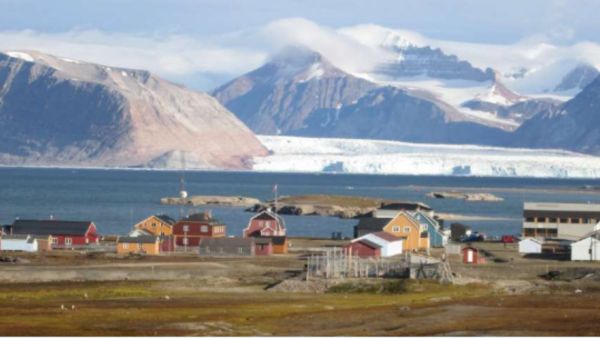 Research stations of ten countries in Ny-Ålesund (Source: Ministry of Earth Sciences)
Based on the feedback from Norwegian counterparts, India has now decided to employ a station manager who will be present at Himadri at all times and ensure smooth functioning of the visiting research teams. “It is important to deploy station managers from NCPOR for liaisoning with Norwegian agencies. The process for the hiring has been initiated,” Thamban Meloth, Director of NCPOR told The Indian Express.
The station manager will help and facilitate the visiting participants in their observation, be responsible for the maintenance of the instruments and field sampling. India, along with Italy and Japan, share the facilities at the Gruvebadet laboratory – located at about 1.25 km away from Himadri. During the recent winter expedition, lightning observation instruments were installed for long-term observations.

Including India, there are at least ten countries that have set up permanent research facilities at the International Arctic Research base in Ny-Ålesund, Norway, located at about 1,200 km from the North Pole. Four hundred Indian researchers have visited Himadri during summer research expeditions since 2008.
Winter expeditions, in particular, are challenging to organise due to inclement weather, prolonged nights lasting up to three to four months, wildlife threat, frozen waters, limited mobility and minimum logistics. That is why only a handful of countries have, so far, undertaken winter expeditions in the Arctic.
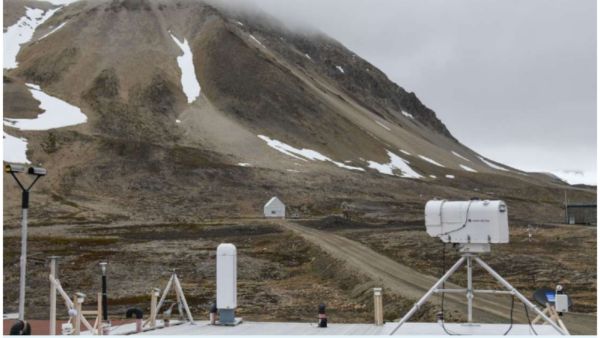 The Gruvabadet Atmospheric Laboratory, which India shares with Italy and Japan, is the northern-most atmospheric lab (Source – MoES)
Prior to winter 2023, India operated Himadri for 180 days per year during the summer season. Norway heavily supports visiting researchers with local logistics and other requirements for their smooth functioning while at Ny-Ålesund. Since the recent winter, Himadri has been equipped for undertaking observations during polar nights (that last longer than 24 hours), and the hosts supply special winter gear, transport facilities and logistics.
The winter expedition had its own challenges, said Rohit Srivastava, Scientist-Incharge, Arctic Expedition Logistics at NCPOR. “The team and scientific cargo movements were affected due to bad weather. The collection of samples from fjords and the coast were also not possible due to the frozen conditions and difficulty of operation of scientific boats. So, we plan to advance the movement of the scientific cargo towards the end of the summer season,” he said.
Some promising initial scientific outcomes have already emerged from the winter expedition projects which spanned areas of astronomy, atmospheric science, biology and life sciences, and space science. In particular, early analysis of the Radio Frequency Interference (RFI) measurements in the locality suggested that the site at the Arctic holds potential for performing Shaped Antenna measurement of the background Radio Spectrum (SARAS-4) experiment within 100-200 Megahertz radio frequency range.
Biodiversity changes in fish that survive sub-zero temperatures were noted and identified. Cosmic ray observations and their fluctuations showed correlations with solar activity and the atmospheric phenomenon.
The NCPOR, operating under the Ministry of Earth Sciences, is the nodal agency responsible for the planning and execution of research expeditions to the Arctic, the Antarctic and the Himalayas. The officials added that in future, NCPOR would encourage novel project ideas that require Arctic winter setting, darkness for performing observations within limited mobility.