

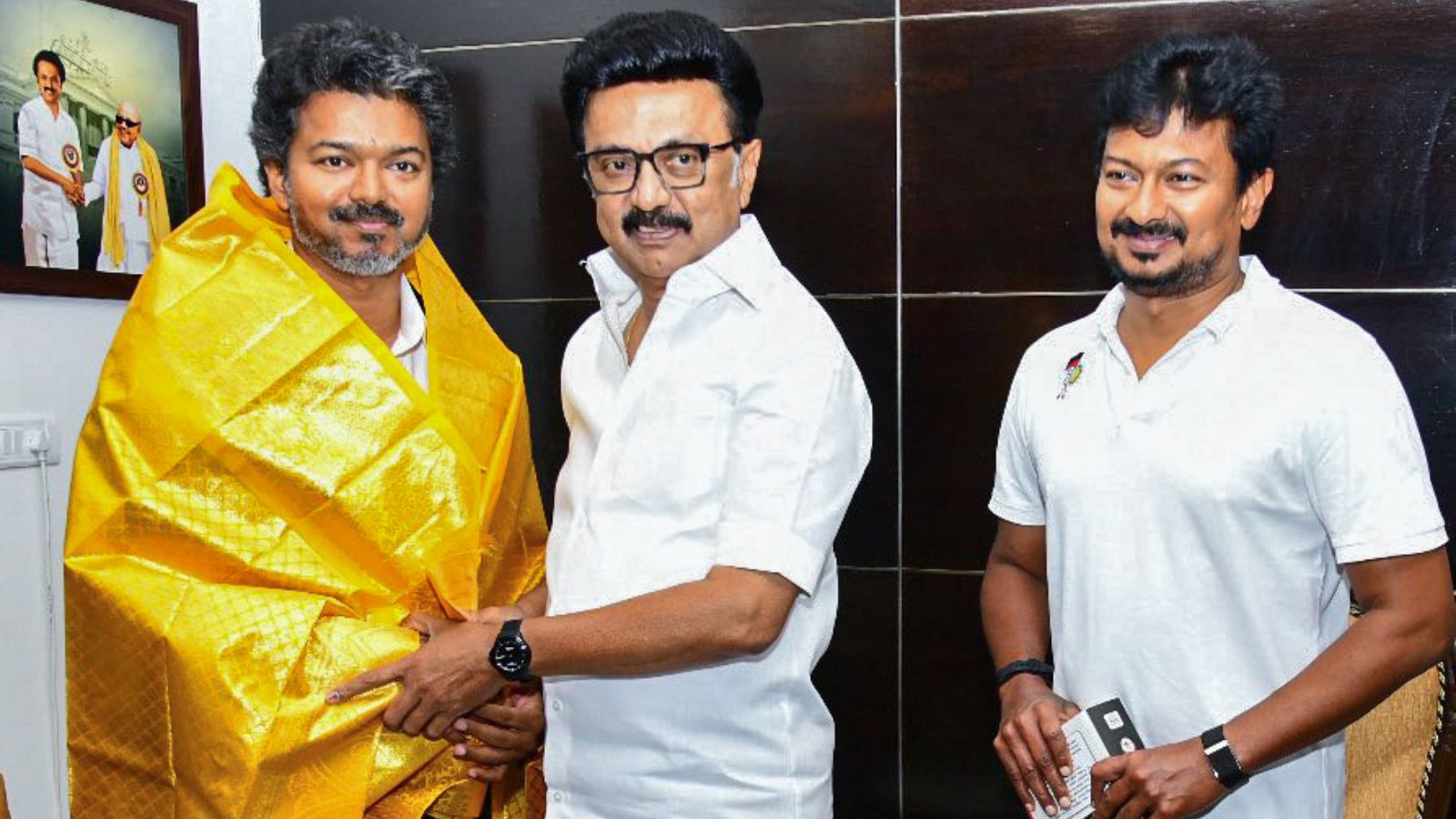
On Monday morning, as the 17th Tamil Nadu Assembly convened for the first time, Udhayanidhi Stalin, walked into a chamber that suddenly looked unfamiliar even to the leaders who once controlled it. Across the aisle sat Chief Minister C Joseph Vijay in a suit.
Behind Vijay, 51, sat a legion of the TVK’s young, first-time MLAs: political debutants, booth workers, digital creators, fan club organisers, meme-makers, and ex-YouTubers, many of them under 40 and apparently more comfortable with Instagram algorithms than the Assembly conventions. Led by Vijay, they have just broken six decades of the Dravidian majors’ dominance.
On the other side was the old order, compressed together for the first time, with the legislators of the arch rivals DMK and AIADMK – parties that spent half a century taking on each other – sitting together in the newly elected House.
The sight was stark. Tamil Nadu politics has always operated like a rotating inheritance system: one Dravidian giant ruled, the other one sat in the Opposition. Now both parties have been pushed together into the same Opposition corner by the film superstar-turned-politician whom they had once dismissed as politically “unserious”.
Among them sat Udhayanidhi, 48, the son of DMK supremo and ex-CM M K Stalin, who has been named the Leader of the Opposition (LoP) in the Assembly by the party MLAs.
For years, the Tamil Nadu political circles believed that Udhayanidhi and Vijay represented the future of politics and cinema, respectively, in the state. The election reversed the script. The contrast between the two men had always been striking.
Vijay entered politics after acting in nearly 70 films over three decades, becoming perhaps the biggest superstar of his generation. Udhayanidhi acted in around 20 films, mostly urban comedies and mid-scale dramas produced under the banner of the DMK first family-controlled Red Giant. Vijay built fandom into political capital. Udhayanidhi inherited political capital before attempting to build on it.
Story continues below this ad
Even their filmographies tell different stories about Tamil ambition and masculinity. Vijay’s career was built through repetition, reinvention and survival across decades of intense film competition. Udhayanidhi’s movies remained lighter, safer, often self-conscious – the charming man rather than the mythic hero carrying fandom on his shoulders.
During the campaign for the recent Assembly elections, their differences turned political. While Stalin and Udhayanidhi crisscrossed the state holding rally after rally, the DMK’s attacks were not directed at the TVK. Udhayanidhi repeatedly targeted AIADMK leader Edappadi K Palaniswami or EPS and the BJP. Vijay was criticised occasionally, but he was never treated as a principal threat. Inside the DMK ecosystem, the assumption lingered that the TVK’s rise was atmospheric rather than structural.
This misreading would now define this election. For nearly five years, the DMK had built one of the most sophisticated political communication systems in the country, which comprised poll consultancy firms like the I-PAC and PEN besides other campaign-management outfits operating under the influence of Stalin’s son-in-law Sabareesan and strategists close to Udhayanidhi. There were digital teams, influencer networks, meme pages, YouTube channels, paid consultants, image managers, political content creators, data analysts, and media persons.
Crores were spent on narrative management. The state’s political internet became crowded with explainers, reels, “independent” commentary and hyper-professional campaign content.
Story continues below this ad
And, yet, all of it could not apparently gauge what was happening on the ground. Not the strategists. Not sections of the media. Not even state intelligence. For, by the time the entire results were declared, even Stalin lost from his own constituency.
Stalin’s defeat did more than reduce the DMK numerically. It dealt a psychological blow to the party. The shock was so deep that sections within both the DMK and the AIADMK briefly entertained one of the strangest ideas in the state’s modern political history: a possible arrangement between the two Dravidian adversaries to prevent Vijay from taking office.
The proposal now sounds improbable even to many within these two parties. But for at least four days last week, it was seriously discussed. Fear does strange things to political systems. Part of that fear was based on practical ground: power, investigations, targeting of the old dispensation, bureaucratic networks, money, influence. But its another part was historical. Inside Tamil Nadu’s entrenched political class, there seems to be a deep worry that Vijay might become another MGR – a populist actor-politician capable of ruling for a decade or more while reducing older parties to resentful survivors. The irony was hard to miss. Parties that mocked Vijay as merely an entertainer suddenly began reorganising themselves to keep him at bay.
Udhayanidhi’s arc
Now, Udhayanidhi sits inside the Assembly facing the consequences of the DMK’s miscalculations. For years, he was projected as Stalin’s political heir. Unlike his father, who spent decades waiting under Karunanidhi’s shadow, faced arrest during the Emergency and fought prolonged internal battles, Udhayanidhi’s rise was remarkably smooth. From the DMK’s youth wing chief to MLA from a safe constituency Chepauk-Thiruvallikeni, to minister and deputy CM – all achieved within nearly half-a-decade. He managed to retain his seat this time too, albeit with a sharply reduced margin.
Story continues below this ad
The criticisms followed him throughout this ascendancy: Dynasty, entitlement, film-industry monopolies, Sabareesan’s influence, and a controversy over his Sanatan dharma remarks. And yet, reducing him merely to privileges misses something about his transformation.
Those close to Udhayanidhi often describe him as someone who entered politics without deep ideological preparation but gradually began absorbing its emotional grammar. He was never seen as a classic DMK ideological warrior. His films avoided overt propaganda. His public image remained lighter than political. But over time, especially after the Sanatan dharma remark row erupted nationally, he appeared to become ideologically serious, more combative and more conscious of the historical weight of the movement he inherited.
He learned quickly how modern politics works rhetorically. He became sharper in speeches, more agile in confrontation, more willing to provoke. But this election exposed another truth: rhetorical sharpness is not always enough when history itself changes direction. Now the Assembly physically reflects that shift.
The Congress members also sit on the Treasury benches for the first time in nearly six decades. On the Opposition benches, the legislators of the DMK and the AIADMK – parties that built modern Tamil Nadu by opposing each other – adjust awkwardly to a geometry the state had never imagined. Senior Dravidian veterans who once moved through the Assembly with the ease of permanent rulers now watch first-time MLAs who are younger, restless and less ideological.
Story continues below this ad
If the scenes of counting day and Vijay’s swearing-in reflected the first-day-first-show celebrations outside cinema theatres, Monday’s Assembly sitting looked different – it was like the first morning of a class room in the new academic year with unfamiliar students. The House seems to be full of uncertain hierarchies and suppressed curiosities about who belongs where now.
And perhaps that is what unsettles the old parties most. Not merely defeat. But unfamiliarity. For decades, the DMK and the AIADMK understood each other well. Their rivalry was fierce but structured. They knew the rules, calculations and triggers.
The TVK disrupted that language and grammar. It arrived through fandom, digital culture, emotional recall and anti-system fatigue rather than through the traditional pathways of cadre politics. It defeated not only parties but assumptions about how Tamil Nadu could behave electorally.
Now, Udhayanidhi must lead the Opposition amid this altered reality. He remains young by traditional political standards and one of the most recognisable faces in state politics. He remains heir to the state’s most durable political machine. But for the first time in his political innings so far, inevitability has disappeared around him. Opposite him sits a film star who was never supposed to take the political world by storm so quickly.
Story continues below this ad
The new Assembly is also going to be marked with bad blood and wounded egos involving several leaders who are still struggling to figure out the stunning verdict delivered by the voters.
Disclaimer: We do not own any of the content, ideas, images, or text presented here. All rights belong to their respective owners. For more information and to view the original source, please visit the following link: