

Notice: Function wp_get_loading_optimization_attributes was called incorrectly. An image should not be lazy-loaded and marked as high priority at the same time. Please see Debugging in WordPress for more information. (This message was added in version 6.3.0.) in /home/ordinar1/parlournews.in/wp-includes/functions.php on line 6170
When one thinks of Paris, one thinks of the Eiffel Tower. In 2024, one thinks of the Paris Olympic and Paralympic Games too. And athletes from around the world who will finish on the podium at Paris 2024 will get to take home a piece of the Eiffel Tower. On Thursday, the organisers announced that the medals to be handed out at the Summer Games will be set with hexagon-shaped tokens forged out of scrap metal from the iconic monument.
The idea was to link the Games with the symbols of France, said Thierry Reboul, creative director of Paris 2024. “The absolute symbol of Paris and France is the Eiffel Tower,” Reboul told reporters. “It’s the opportunity for the athletes to bring back a piece of Paris with them.”
The Olympic medals usually follow a theme. Last time around, the medals were moulded from metal extracted from recycled consumer electronics as part of the Tokyo 2020 Medal Project, which involved Japanese citizens donating electronic devices for the cause.
For the Paris medals, the original iron of the Eiffel Tower is cut into a hexagon, the geometric shape that evokes France to the point of being its nickname. Stripped of its Eiffel Tower brown paint, the puddle iron has been restored to its original colour. Placed in the centre and embossed with the emblem of the Olympic Games Paris 2024, this piece of heritage blends with gold, silver and bronze to give the medals a two-tone side.
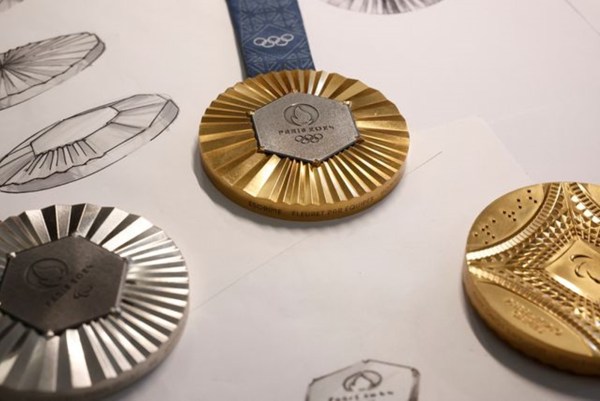 A Paris 2024 Olympic Games gold medal is seen on display with Paralympic Games gold and silver medals at Chaumet jewellery (REUTERS)
Designed by jeweller Chaumet, the 18-gram hexagon tokens, representing the shape of France, are made of iron taken from the Tower during past refurbishments and then stored for years in a warehouse whose location is secret, as per Reuters. They sit in the centre of the gold, silver and bronze medals, ringed with grooves evoking light rays bursting outward – drawn from a tiara design in Chaumet’s archives.

The three design elements on the back side are the hexagon with the iron from the Tower, the radiance, and the setting. The radiance is represented by fine lines (rays) projected at regular intervals around the iron hexagon, adding a 3D effect. The hexagon is finally linked to the medal by a “claw setting”. Six metal appendages are stamped on the surface and placed at the six corners of the hexagon to enclose the piece of iron against the medal. The claws are reminiscent of the rivets on the Eiffel Tower.
The IOC stipulates that the front side of Olympic medals (obverse) must have Nike – the Greek Goddess of Victory – standing in the Panathinaiko Stadium and the full name of the Games edition. That is no different for Paris as well.
Unique symbol of a dream coming true.
The ultimate reward for a victory or a podium finish!
They carry in their hearts an actual fragment of the Eiffel Tower.
Here are the #Paris2024 Olympic and Paralympic medals.@Olympics @Paralympics pic.twitter.com/08VLwyVwq6— Paris 2024 (@Paris2024) February 8, 2024
For the Paralympic medals, a graphic representation of a low-angle view under the Eiffel Tower will be used. The words “Paris” and “2024” frame the pillars of the Tower and are written in universal Braille. To enable the three metals to be distinguished by touch, lines are engraved on the edge of the medal won: I for gold, II for silver and III for bronze.
The 5,084 medals are produced by France’s mint. A hundred years after producing the medals for the 1924 edition, the Monnaie de Paris is once again in charge of manufacturing these medals.
The first medals of the modern Olympic Games presented in Athens in 1896 were, incidentally, designed by Frenchman Jules-Clément Chaplain and also made in France. Back then, winners were rewarded with a silver medal and the second-place finishers with a bronze. St. Louis 1904 was the first time gold, silver and bronze were awarded to the top three. Interestingly, the medals from the 1900 Olympics – when Paris hosted for the first time – stand out as the only rectangular example from the Summer Games.