

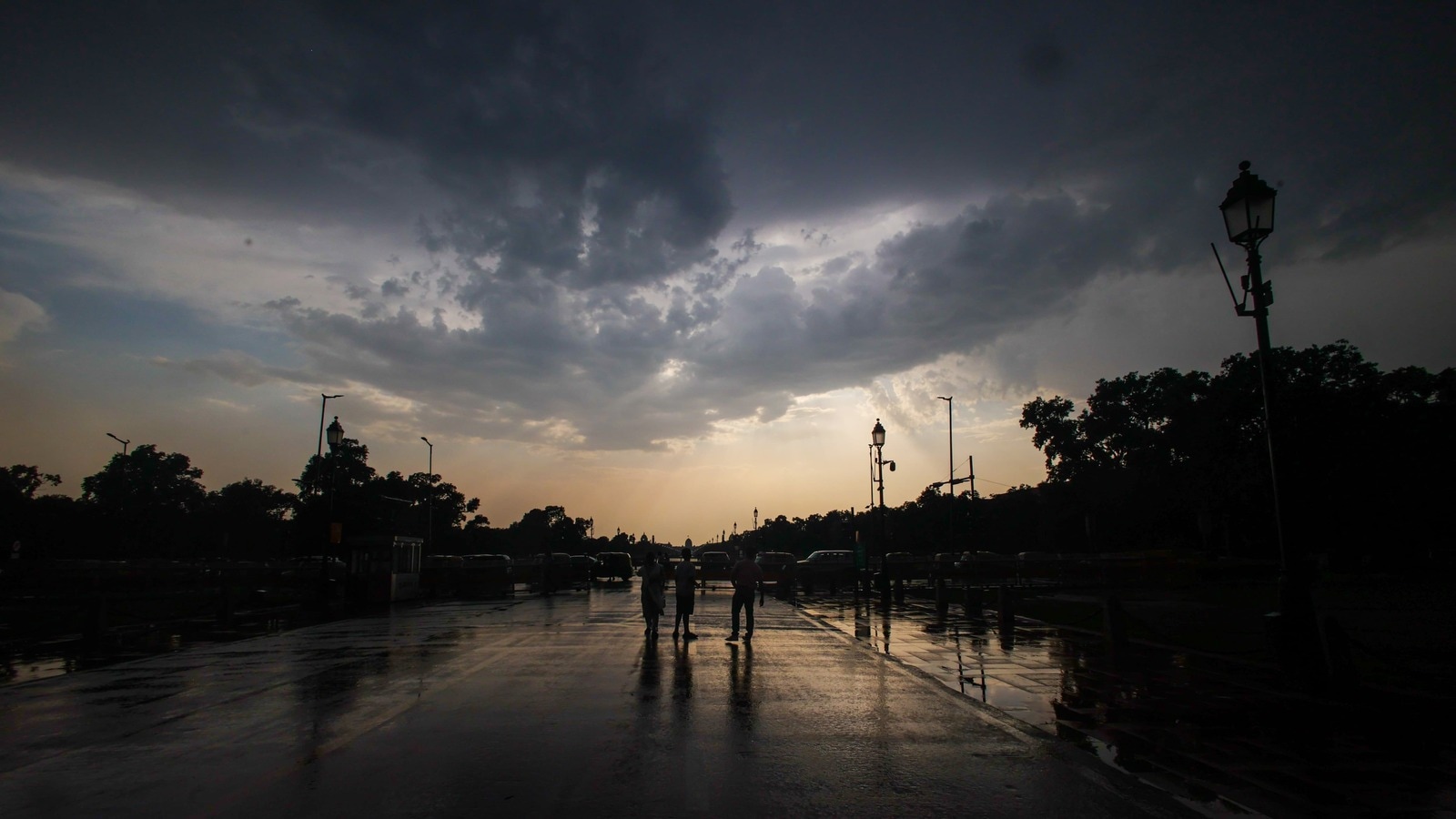
Delhi-NCR Weather LIVE Updates: An orange alert has been issued for Delhi-NCR by the India Meteorological Department (IMD), forecasting moderate thunderstorms accompanied by gusty winds and light rainfall across the region on Friday evening.
The alert (to be prepared/updated) comes just a day after a surge of dust-laden winds from Pakistan and western Rajasthan pushed air quality to ‘poor’ levels and reduced visibility in the Capital.
The IMD, in an update at 5.30 pm, confirmed that a convective system — an intense, localised weather phenomenon characterized by the rapid upward movement of warm, moist air — which earlier entered Delhi from Rohtak, has now crossed the Capital. It is currently hovering over Noida, Ghaziabad, and Faridabad.
The storm is bringing winds of 40–50 kmph, with gusts touching 60 kmph, and is accompanied by intermittent rainfall and lightning activity.
As per the IMD’s definition, Friday’s weather warning qualifies for a moderate thunderstorm event. These typically involve wind speeds between 30–60 kmph, light to moderate rainfall, and frequent lightning.

In a nowcast issued earlier in the evening, the IMD warned of a southeastward-moving convective system over Rohtak in Haryana. This system is expected to move into Northwest Delhi within the hour, bringing with it winds gusting at 40–60 kmph, localised rain, and lightning, the officials said.
The weather alert, in effect till 6.30 pm, covered the whole of Delhi and parts of NCR, including Noida, Gurgaon, Faridabad, and Ghaziabad.
Story continues below this ad
While the rainfall brought brief respite from the heat and suspended dust, the air quality across the Capital remained ‘poor’, with an average AQI of 278 as of 2 pm, just marginally better than Thursday’s 292.
What caused the sudden weather change?
The sudden weather change in Delhi is attributed to a convective system. This convective activity over Rohtak moved southeastward, entering Delhi and NCR, causing thunderstorms, gusty winds, and localised rainfall.
Simultaneously, strong northwesterly winds had earlier carried dust particles from arid regions of Pakistan and western Rajasthan into Delhi-NCR, leading to poor air quality and reduced visibility.
Light rain lashed Noida, Ghaziabad, and Faridabad, as per IMD officials.
Story continues below this ad
Sudden thunderstorms, gusty winds, and dust surges are typical pre-monsoon phenomena driven by atmospheric instability because of uneven heating.
In the coming six days, the Met department said rain and thunderstorms will bring down temperatures. A thunderstorm with wind is forecast on Saturday. On Sunday, strong surface winds during the day have been forecast.
A lack of heat in the atmosphere, as partly cloudy skies are forecast from May 19 to 22, also means that the maximum and minimum temperatures would gradually decrease. The IMD has said that it would hover around 25 to 38 degrees Celsius by May 22 — the same day, there is also a possibility of rain or thunderstorm.
How is the air quality in the capital?
After dust-laden winds blew into Delhi, visibility had plunged rapidly from 4,500 metres to about 1,200 metres within 90 minutes on Wednesday night. The IMD, however, clarified that the episode did not qualify as a dust storm, since visibility remained just above the 1,000-metre threshold required under its classification system.
Story continues below this ad
But its effects were felt sharply across the city, even on Friday.
Wazirpur recorded the worst air quality, with PM 10 levels peaking at 847 µg/m³, over eight times the safe limit of 100. PM 2.5 concentrations also remained extremely high at 248 µg/m³, well above the 24-hour permissible limit of 60.
Stations at Anand Vihar, Rohini, and Bawana-Pooth Khurd also reported PM10 levels above 500 µg/m³
The Indian Institute of Tropical Meteorology (IITM) has forecast continued poor air quality for Friday and Saturday, with improvement expected only from Sunday.
Disclaimer: We do not own any of the content, ideas, images, or text presented here. All rights belong to their respective owners. For more information and to view the original source, please visit the following link: