

PM: Step out of comfort zone, time for India’s quantum jump
Syllabus:
Preliminary Examination: Economic and Social Development-Sustainable Development, Poverty, Inclusion, Demographics, Social Sector Initiatives, etc.
Main Examination: General Studies III: Indian Economy and issues relating to planning, mobilization, of resources, growth, development and employment.
What’s the ongoing story: Urging the youth to step outside their “comfort zone” while underlining that this is the time for a “quantum jump” to have a developed nation by 2047, Prime Minister Narendra Modi said Sunday that India is rapidly moving towards a $5-trillion economy and will surpass the $10-trillion mark by the end of the next decade.
Key Points to Ponder:
• What is ‘Viksit Bharat by 2047’?
• What is the meaning of becoming a $5-trillion economy?
• What is the goal of ‘Viksit Bharat by 2047’ as envisioned by the Government of India?
• In the context of India’s development goals, what does the term ‘demographic dividend’ refer to?
• The role of youth in achieving the vision of ‘Viksit Bharat by 2047’-Comment
• How can government policies empower the younger generation to contribute effectively?
• “India’s demographic dividend is a double-edged sword”-Decode the statement
• What are the ethical responsibilities of the government, society, and individuals in shaping a ‘Viksit Bharat by 2047.
Key Takeaways:
• Addressing a gathering at the Viksit Bharat Young Leaders Dialogue in New Delhi on National Youth Day, Prime Minister Modi said the country also hopes to host the Olympics in the next decade and is working towards it with full dedication.
• He said India has made rapid strides in the last 10 years and the youth will not only drive the greatest transformation in the country’s history but also be its biggest beneficiaries.
• Modi said the youth must take ownership of the Viksit Bharat goal and assured them that the ideas presented during the dialogue would become part of the country’s policies.
• He said India is making rapid strides as a space power, with plans to establish a space station by 2035. He noted the success of Chandrayaan and the ongoing preparations for Gaganyaan, with the ultimate aim of landing an Indian on the Moon. He emphasised that achieving such goals will pave the way for a developed India by 2047.
• The Prime Minister expressed confidence that with a large young population, India will have a “golden period” over the next 25 years. “I can imagine a Viksit Bharat, one which is economically, socially, and strategically strong. This is the moment for India to take a quantum jump and it will only happen by acting upon our ideas.”
• “India is now nearly a $4-trillion economy, significantly increasing its capabilities. The current infrastructure budget is over 11 lakh crore rupees, nearly six times higher than a decade ago, and more is being spent on railways alone than the entire infrastructure budget of 2014,” he said. This increased budget, he said, is evident in India’s changing landscape, with Bharat Mandapam being a beautiful example.
Do You Know:
• Essentially the reference is to the size of an economy as measured by the annual gross domestic product or GDP. As a thumb rule, the bigger the size of the economy, the more prosperous it can be expected to be.
• The GDP of an economy is the total monetary value of all goods and services produced in an economy within a year. There are many ways to calculate a country’s GDP. You could aggregate the total production, or you could add up all the income earned by the people, or you could add up all the expenditure made by the entities (including government) in the economy. For most international comparisons, GDP is calculated via the production method (that is, adding up the value-added at each step) and the monetary value is arrived at by using current prices in US $.
Other Important Articles Covering the same topic:
📍Economy to hit $5 trillion by 2026: Economist Arvind Panagariya
UPSC Prelims Practice Question Covering similar theme:
1. Which of the following is a key objective of India’s target of becoming a $5 trillion economy?
1. Achieving higher foreign direct investment
2. Improving financial inclusion
3. Strengthening manufacturing under “Make in India”
4. Reducing fiscal deficit below 1%
Select the correct answer using the code below:
(a) 1 and 2 only
(b) 1, 2, and 3 only
(c) 2, 3, and 4 only
(d) 1, 2, 3, and 4
UPSC Mains Previous Year Question Covering similar theme:
📍Define potential GDP and explain its determinants. What are the factors that have been inhibiting India from realizing its potential GDP? (2020)
In docking trial bid, ISRO brings satellites to 3-metre distance, puts out images
Syllabus:
Preliminary Examination: Current events of national and international importance.
Main Examination: General Studies III: Awareness in the fields of IT, Space, Computers, robotics, nano-technology, biotechnology and issues relating to intellectual property rights.
What’s the ongoing story: The Indian Space Research Organisation (ISRO) brought the two SpaDeX satellites as close as 3 metres to each other on Sunday morning as they continued moving at high speeds in the orbit.
Key Points to Ponder:
• Explain the significance of the SpaDeX experiment by ISRO in advancing India’s space capabilities?
• How does mastering docking technology impact future space missions?
• What is the role of satellite docking technology in the development and maintenance of space stations?
• How does docking technology align with India’s aspirations for human spaceflight missions like Gaganyaan?
• What are the technical and operational challenges in achieving satellite docking in space?
• Highlight the strategic and geopolitical significance of mastering docking technology in the global space race.
Key Takeaways:
• After completing the manoeuvre, the space agency moved the satellites away from each other again.
• “A trial attempt to reach up to 15 m and further to 3 m is done. Moving back spacecrafts to safe distance,” the space agency said in a statement. It added, “The satellites will be brought back to the positions and the docking attempted only after analysing the data.”
• The satellites were left at a distance of 230 metres from each other on Saturday night (11th Jan 2025)
• Early next morning (12th Jan 2025), ISRO brought the satellites first to 105 metres from each other. The satellites were captured as tiny specks by the on-board video camera.
• The satellites were then brought to 15 metres and the position held steady. Both the satellites were then clearly visible on the on-board cameras.
• ISRO had to postpone the docking plans on two earlier occasions, on January 7 and January 9, because the satellites had not been able to achieve the required alignment.
Do You Know:
• As per the docking plan, the Chaser satellite is supposed to be progressively brought closer to the Target satellite, holding positions at a distance of 5 km, 1.5 km, 500 m, 225 m, 15 m, and 3 m, before joining together. All the hold points were accomplished on Sunday.
• Once the satellites dock with each other, the space agency will also demonstrate exchanging electrical power between the two and giving commands to the composite spacecraft as one. •
• A successful docking would make India the fourth country in the world — after United States, Russia, and China — to have achieved space docking.
• Spadex mission is designed to demonstrate space docking — a process by which two fast-moving satellites or spacecrafts are brought into the same orbit, brought closer together, aligned autonomously or manually, and finally joined. This capability is necessary for carrying out missions that require bigger payloads that a single launch cannot carry.
• The first actual Indian mission requiring the docking capability is likely to be Chandrayaan-4, which is supposed to bring lunar samples back to Earth. The re-entry module of this mission, which will be designed to withstand the heat of re-entry to the Earth’s atmosphere, is planned to be launched separately. The transfer module carrying samples from the Moon will come and dock with the re-entry module in the Earth’s atmosphere.
• Docking would also be required for setting up the Bharatiya Antariksh Station. The first module is planned to be launched in 2028. It is supposed to have five modules, which are expected to be launched separately and brought together in space. The human mission to Moon, which would also require the capability, is not expected to happen before 2040.
Other Important Articles Covering the same topic:
📍Express View on ISRO’s SpaDeX mission: A tryst in space
UPSC Prelims Practice Question Covering similar theme:
2. Docking and proximity operations are essential for which of the following space exploration goals?
(a) Deep space exploration missions
(b) Space station assembly and operation
(c) Mars and Moon colonization projects
(d) All of the above
GOVT & POLITICS
Anthem row intensifies in TN as Ravi slams CM ‘arrogance’
Syllabus:
Preliminary Examination: Indian Polity and Governance-Constitution, Political System, Panchayati Raj, Public Policy, Rights Issues, etc.
Mains Examination:
• General Studies II: Appointment to various Constitutional posts, powers, functions and responsibilities of various Constitutional Bodies.
• General Studies II: Functions and responsibilities of the Union and the States, issues and challenges pertaining to the federal structure, devolution of powers and finances up to local levels and challenges therein
What’s the ongoing story: Tamil Nadu Raj Bhavan Sunday lashed out at Chief Minister M.K. Stalin for calling Governor R N Ravi “childish” after the latter staged a walkout during the opening session of the Tamil Nadu Assembly, citing disrespect to the national anthem.
Key Points to Ponder:
• What is the current conflict between the governor and the government in Tamil Nadu?
• “The standoff between the Tamil Nadu government and R N Ravi highlights a significant constitutional dilemma about the role and powers of the Governor”-Elaborate
• Discuss the constitutional role of the Governor in India’s federal structure.
• How do conflicts between Governors and Chief Ministers impact governance at the state level?
• Examine the significance of symbols like the National Anthem in fostering national unity?
• Highlight the constitutional provisions governing the relationship between the Governor and the Chief Minister.
• “The Governor’s office should act as a neutral and constitutional authority.” Critically evaluate this statement in light of recent
controversies.
• Analyse the ethical responsibilities of constitutional authorities like the Governor in maintaining decorum and fostering cooperative federalism.
Key Takeaways:
• In a post on X, Ravi expressed his disapproval of Stalin’s remarks, accusing him of arrogance and betraying the true intentions of the coalition. The Governor warned that Bharat is supreme and will not tolerate such insults.
• The row began when when Governor Ravi on January 7 abruptly walked out of the Tamil Nadu Assembly citing a breach of protocol after the National Anthem was not played at the start of the session.
• In response, Stalin criticised the governor’s actions, calling them “childish”. “The Governor comes to the Assembly but returns without addressing the House. That’s why I said his actions were childish,” Stalin said in the Assembly.
• Stalin also pointed to a breach of constitutional protocol, saying that, under Article 176, the governor is required to address the Legislative Assembly at the start of the session. “But he seems intent on violating the rules in a planned manner,” Stalin added, wrapping up the debate on the motion of thanks to the Governor’s address.
Do You Know:
• The clash over the national anthem is the latest in a series of disputes over ceremonial and constitutional practices. According to Assembly protocol, the Tamil Thai Vaazhthu is performed at the opening of proceedings, while the national anthem is sung at the end of the day’s session. The Raj Bhavan’s insistence on changing this protocol is seen as an overreach by the DMK government.
• The drama unfolded when the Assembly convened for its first session of the year. As per tradition, the session began with the recital of the Tamil Thai Vaazhthu, the state’s official song. However, the absence of the national anthem triggered objections from the Governor, who reportedly appealed to Chief Minister M K Stalin and Speaker M Appavu to ensure its inclusion. His request was declined, prompting Ravi to leave the Assembly less than five minutes after the session began.
Other Important Articles Covering the same topic:
UPSC Previous Year Question Covering similar theme:
3.Which of the following are the discretionary powers given to the Governor of a State? (2014)
1. Sending a report to the President of India for imposing the President’s rule
2. Appointing the Ministers
3. Reserving certain bills passed by the State Legislature for consideration of the President of India
4. Making the rules to conduct the business of the State Government
Select the correct answer using the code given below
a) 1 and 2 only
b) 1 and 3 only
c) 2, 3 and 4 only
d) 1, 2, 3 and 4
EXPRESS NETWORK
Dhaka summons Indian envoy over fencing row
Syllabus:
Preliminary Examination: Current events of national and international importance.
Main Examination: General Studies II: India and its neighbourhood- relations.
What’s the ongoing story: Bangladesh faced off with India Sunday over tensions at the border as the neighbouring country’s foreign ministry summoned High Commissioner Pranay Verma to express “deep concern” over “recent activities of the Border Security Force (BSF)”.
Key Points to Ponder:
• Know the key issues contributing to border tensions between India and Bangladesh.
• Analyse the impact of the Land Boundary Agreement (LBA) on India-Bangladesh relations.
• “India-Bangladesh relations are a mix of cooperation and conflict.” examine this statement in the context of recent border tensions.
• The importance of India’s relationship with Bangladesh for ensuring regional security and development in South Asia-Comment
• What are the short and long term implications of illegal immigration, smuggling, and trafficking in escalating tensions along the India-Bangladesh border?
Key Takeaways:
• This came hours after Dhaka alleged that India was attempting to construct fences at five locations along the Indo-Bangla border, violating a bilateral agreement.
• After meeting Bangladesh Foreign Secretary Jashim Uddin, the Indian High Commissioner said: “I just met Foreign Secretary to discuss India’s commitment to ensuring a crime-free border, effectively addressing challenges of smuggling, movement of criminals and
trafficking.”
• “We have an understanding with regard to fencing the border for security. BSF and BGB (Border Guard Bangladesh) have been in communication in this regard. We expect that understandings will be implemented and there will be a cooperative approach to combating crime,” Verma said in Dhaka.
• Earlier in the day, Bangladesh Home Affairs Adviser Lt Gen (retd.) Jahangir Alam Chowdhury said that India had halted the construction of barbed wire fencing along the border after strong opposition from the BGB and local residents.
• According to the Bangladesh Foreign Ministry, Jashim Uddin told the Indian envoy that the “unauthorized attempt” to construct fences and related operational actions by BSF have caused tensions along the border.
Do You Know:
• The chequered history of Bangladeshi democracy has seen periodic interventions by the military. The army appointed Chief Justice Abu Sadat Mohammad Sayem as president in November 1975, and the country was ruled by a military junta.
• In 1977, Gen Ziaur Rahman became president; he was assassinated in 1981 and his successor Abdus Sattar was removed in a coup in 1982. Army chief H M Ershad took control, but mass unrest led to his resignation in 1990.
• The civilian governments of Khaleda Zia, widow of Gen Ziaur Rahman (1991-96 and 2001-06), and Sheikh Hasina (1996-2001) followed. In between, there was an attempted coup in 1996.
• Following widespread unrest at the end of Khaleda’s term in 2006, the military asked the then president to declare an emergency. A caretaker government was in charge from January 2007 to December 2008.
• After Hasina came back to power in 2008, she made sure that the army returned to the barracks. In 2010, the Supreme Court reduced the scope for military interventions through legal loopholes, and reaffirmed the secular principles of the Bangladesh constitution.
Other Important Articles Covering the same topic:
UPSC Prelims Practice Question Covering similar theme:
4.Which river is often a source of tension between India and Bangladesh due to water-sharing disputes?
(a) Ganga
(b) Brahmaputra
(c) Teesta
(d) Meghna
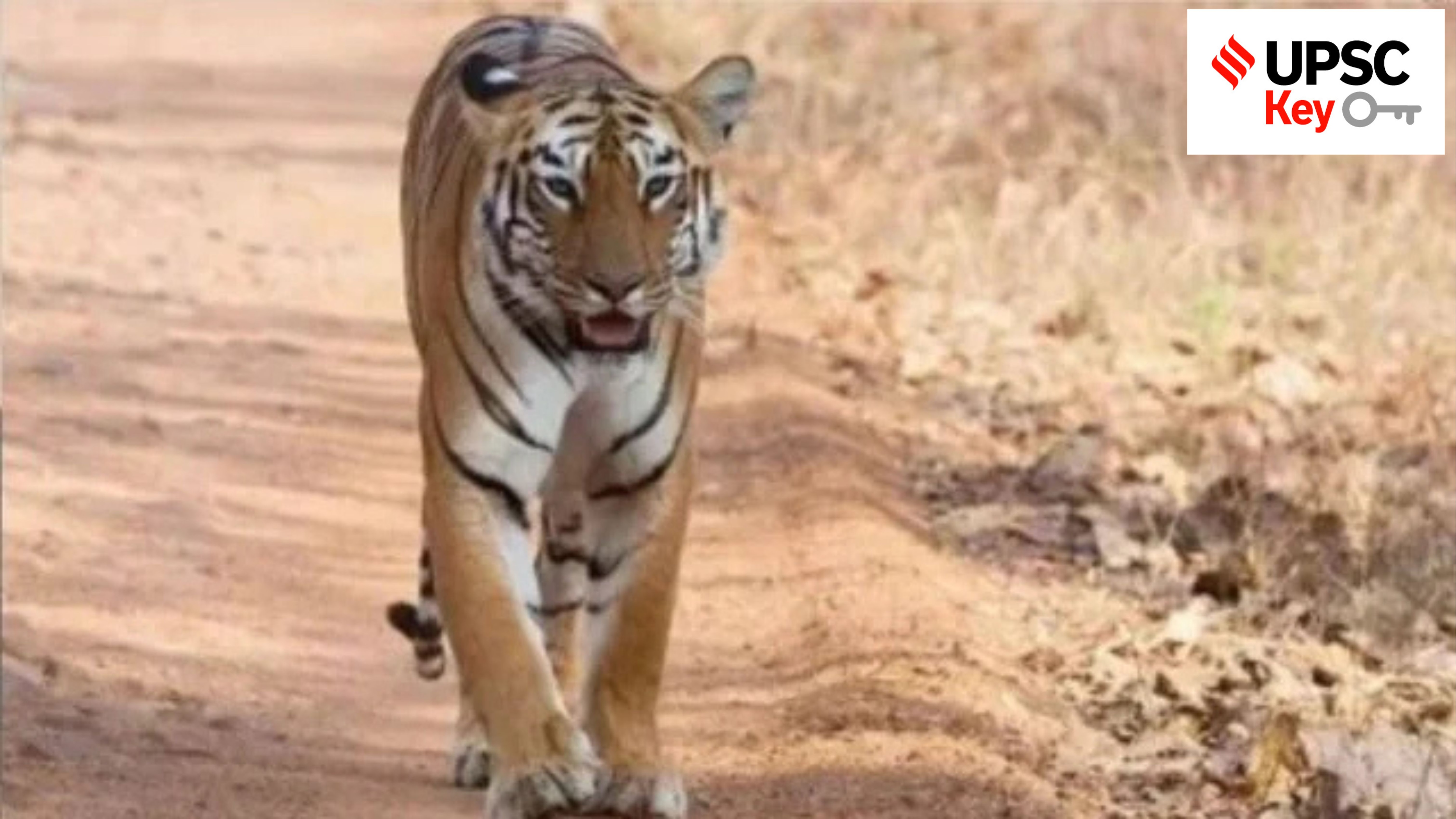
Another tiger enters Bengal, state says won’t return it
Syllabus:
Preliminary Examination: Current events of national and international importance.
Main Examination: General Studies III: Conservation, environmental pollution and degradation, environmental impact assessment.
What’s the ongoing story: With another tiger entering West Bengal from neighbouring Jharkhand, state forest minister Birbaha Hansda on Sunday said that the big cat would not be returned if captured.
Key Points to Ponder:
What’s the ongoing story: With another tiger entering West Bengal from neighbouring Jharkhand, state forest minister Birbaha Hansda on Sunday said that the big cat would not be returned if captured.
Key Points to Ponder:
• Map Work-Similipal Tiger Reserve Park and other tiger reserves in India
• What are the reasons for tiger migration between states in India?
• How does habitat connectivity influence tiger migration?
• “Interstate cooperation is vital for the success of wildlife conservation in India.” Discuss this statement in light of tiger migration from Jharkhand to West Bengal.
• What are the challenges associated with maintaining tiger corridors in India.
• Examine the role of Project Tiger and the National Tiger Conservation Authority (NTCA) in mitigating conflicts arising from interstate wildlife migration.
• “Wildlife belongs to nature, not to political boundaries.” Discuss this statement in the context of tiger conservation and interstate cooperation.
Key Takeaways:
• This comes close on the heels of tigress Zeenat leaving a trail of panic across five West Bengal districts after wandering off from Similipal Tiger Reserve Park in neighbouring Odisha, leading to a spat between the two state governments.
• “This tiger has come from Jharkhand. It has entered Jhargram. Our forest department officials are on alert and have reached the area. Teams have been deployed… This proves that our forests are suitable for tigers and there is ample prey base or food here. That is why tigers are entering our forests from neighbouring states,” Bengal Forest Minister Birbaha Hansda said.
• In the absence of a radio collar, say experts, it is difficult to identify the home range of the tiger currently moving.
• Forest officials said the latest pugmarks of the tiger has been found in the Banspahari area of Jhargram district.
Do You Know:
• Tiger dispersals are mostly exploratory — they do not follow linear paths, and find their way around barriers such as highways, railways, canals, mines, and human habitation.
• A study of 29 tiger cubs between 2005 and 2011 in Ranthambhore found that males had a greater probability of dispersal (92.3%) than females (36.4%). Males also dispersed further (4.5-148 km) than females (4.6-25.8 km) from the area of birth.
• Typically, a male tiger’s larger territory encompasses smaller territories of multiple female tigers. While related tigresses (siblings or mother-daughters) may concede space to one another in adjacent ranges, every male tiger must establish its own territory when it comes of age.
• Within the finite limits of shrinking forests, this leads to frequent duels between young pretenders and the dominating, mature males already in control of prime plots. If lucky to survive the face-offs, the vanquished flee the victor’s territory.
• For old tigers, such displacement would signal impending death. But with time on their side, the young floaters must keep exploring for vacant slots and accessible tigresses. A tiger forest reaching its carrying capacity is not the only scenario when individual tigers wander outside.
• Tigers are also known to set off when moved to new locations as part of population management strategies. In Madhya Pradesh, for instance, the first male tiger shifted to Panna from Pench in 2009 started walking south, looking for its erstwhile home. It had to be recaptured. Last month, tigress Zeenat showed the same restlessness after being packed away from Tadoba (Maharashtra) to Simlipal (Odisha).
• Tigresses may also disperse to protect cubs. In 2011, a tigress walked out of Ranthambhore with its two cubs after the male that sired them was airlifted to repopulate Sariska. Wary of new males looking to kill the cubs and mate with her, the tigress took refuge in the ravines and mustard fields by the Chambal river, where the cubs did not survive too long.
• Not all dispersals have happy endings. But surplus tigers from ‘source’ reserves must fan out looking to reach low-tiger-density areas. When they succeed, fresh gene flow revitalises isolated populations. When they don’t, they die.
• Also, without adequate monitoring and necessary intervention, tiger dispersals through non-forest areas and human habitations may fuel man-animal conflict, eroding the goodwill the national animal banks on. Dispersal routes popular with tigers indicate the potential for developing and protecting new habitats and corridors so that the big cat may reclaim lost ground.
• According to the latest all-India tiger estimate, one-fifth of India’s tiger area spanning 16 tiger reserves harbours only 25 — or less than 1% — of India’s 3,682 tigers.
Other Important Articles Covering the same topic:
📍Zeenat secured, now West Bengal and Odisha step on the tiger’s tale
UPSC Prelims Practice Question Covering similar theme:
5. What is a possible ecological reason for tigers moving from one state to another?
(a) Overpopulation in the existing habitat
(b) Loss of prey base in the original habitat
(c) Habitat fragmentation and human encroachment
(d) All of the above
THE IDEAS PAGE
The leaders our universities need
Syllabus:
Preliminary Examination: Indian Polity and Governance-Constitution, Political System, Panchayati Raj, Public Policy, Rights Issues, etc.
Mains Examination: General Studies II: Appointment to various Constitutional posts, powers, functions and responsibilities of various Constitutional Bodies.
What’s the ongoing story: Ashok Thakur and S S Mantha Writes: The UGC’s recent draft regulations — Minimum Qualifications for Appointment and Promotion of Teachers and Academic Staff in Universities and Colleges and Measures for Maintenance of Standards in Higher Education — attempt to represent the objectives of the National Education Policy (NEP).
Key Points to Ponder:
• Vice Chancellor in State and Central Universities-About and Role
• Who appoints Vice Chancellor in Central Universities and in State Universities?
• What is the University Grants Commission’s (UGC) role in this?
• New UGC regulations-What are those?
• Examine the process of selecting Vice-Chancellors in Indian universities.
• Analyse the challenges associated with the selection process of Vice-Chancellors in India.
• Evaluate the role of search-cum-selection committees in ensuring transparency and fairness in the Vice-Chancellor appointment process.
Key Takeaways:
Ashok Thakur and S S Mantha writes:
• The VC’s post is central to the functioning of a university. As the academic and administrative head of the university, he/she chairs the council of the university, the board of faculties and the finance committee of the university.
• The VC represents the university externally, both within and overseas. He/she is also responsible for securing the university’s financial base and making it robust enough to allow the delivery of the institution’s mission, aims and objectives.
• The mandate of this post is the creation of knowledge for humanity/universe — the term “university” derives from this objective.
• The regulation clears ambiguities in the formation of the search-cum-selection committee to appoint VCs. Such powers are now vested in the Governor-Chancellors or Visitors. Earlier, the government would seek the nominee of the Governor-Chancellor from a list of three names it supplied.
• The Governor-Chancellor will now nominate his representative. A UGC nominee was always a part of the search panel which is as it should be, since the maintenance of the quality/academic standards is its mandate.
• In recent times, the VC’s post has attracted controversy in some states. Some state governments have tried to replace the Governor-Chancellor with a Chief
• A search committee for the selection of a VC in a US university consists of participants in the university’s processes — senior administrators like provosts, deans, faculty representatives, staff members, even students (occasionally) and trustees or board members.
Do You Know:
• Regulations notified by the University Grants Commission (UGC) in 2018 said that a search-cum-selection committee comprising eminent persons in higher education shall shortlist 3-5 candidates by public notification, nomination, a “talent search process”, or a combination of these processes.
The Chancellor – or Visitor in a central university – appoints the VC from among the recommended names.
• In the case of state and private universities, one member of the search-selection committee is nominated by the UGC Chairman. For state universities, the rest of the committee is constituted in accordance with state law.
• The Kerala University Act, 1974, for example, says the VC will be appointed by the Chancellor “on the unanimous recommendation of a committee appointed by him consisting of three members”, one elected by the university Senate, and one each nominated by the UGC Chairman and the Chancellor (Governor).
• Central universities – there are 56 currently – are established under an Act of Parliament, and are administered by the Centre. The Visitor, their ceremonial head, is the President of India.
The composition of the committee to appoint the VC of a central university is determined by the Act that governs the university.
• For the University of Delhi and Jawaharlal Nehru University, for example, the committee has two nominees of the university Executive Council, and one of the Visitor.
• The draft regulations say “the Chancellor/ Visitor shall constitute the Search-cum-Selection Committee comprising three experts.” The 2018 regulations did not specify who would constitute the committee.
• Unlike the 2018 regulations, the new regulations specify the composition of the committee: a member each nominated by the Visitor/ Chancellor, the UGC Chairman, and the apex body of the university (Senate/ Syndicate/ Executive Council). This gives nominees of the Centre the majority in the committee.
• Besides professors, individuals at senior levels in industry, public policy, public administration, or public sector undertakings, can also become VCs, says the draft.
Other Important Articles Covering the same topic:
📍What draft rules on VC appointments say, why states are upset
ECONOMY
What went wrong with gold import figures and why is revision before Budget crucial?
Syllabus:
Preliminary Examination: Current events of national and international importance.
Mains Examination: General Studies III: Indian Economy and issues relating to planning, mobilization, of resources, growth, development and employment.
What’s the ongoing story: An unusual 331% year-on-year surge in gold imports during November 2024 — which had an impact on the domestic currency almost hitting its all-time low against the US dollar — and subsequent red flags raised by the gold industry has forced the government to undertake a broad-based process of comparing and matching trade data from multiple sources, including tax collection data, to verify accuracy.
Key Points to Ponder:
• Discuss the significance of accurate trade data in macroeconomic planning, with a focus on the recent discrepancies in India’s gold
import figures.
• Analyse the impact of gold imports on India’s trade deficit and current account deficit (CAD).
• How does this affect the formulation of the Union Budget?
• Highlight the role of government agencies in ensuring the transparency and accuracy of trade data.
• Discuss the importance of real-time data integration and technology adoption in the governance of India’s trade and commerce sectors.
Key Takeaways:
• This initial reconciliation effort involving imports between April and November resulted in one of the steepest revisions of gold import figures in the recent past.
• For November alone, the gold import figures were revised down by $5 billion, and cumulatively between April and November, the import figures were revised down by $12 billion to $37 billion.
• This revision was officially attributed to a problem in a data migration process that commenced in July last year. It was discovered subsequently that an error occurred due to the transition of the data transmission mechanism from the Special Economic Zone (SEZ) to the Indian Customs Electronic Gateway (ICEGATE), leading to “double counting” in the case of gold imports.
• The revision comes just weeks ahead of the Union Budget presentation, and assumes significance, as gold imports had been rising to record levels ever since the duty on gold was slashed from 15% to 6% in the last Budget. This had led to calls for tightening the rates in the upcoming Budget to help limit the widening trade deficit, which has contributed to the weakening rupee.
Do You Know:
• In its official explanation of the counting error, the Ministry of Commerce and Industry stated that data from the Commerce Ministry and the Finance Ministry had been reconciled. During the data migration process, it was discovered that an error occurred due to the transition of the data transmission mechanism from the Special Economic Zone (SEZ) to the Indian Customs Electronic Gateway (ICEGATE). The transition came into effect on 1 July.
• The Ministry clarified that the figures for precious metals required revision, as it was found that the system had been counting both imports into the SEZ and subsequent clearances into the Domestic Tariff Area (DTA) as separate transactions after the migration, due to a “technical glitch.”
• The Ministry of Commerce stated that, due to the persistence of “certain technical glitches”, the migration is still not complete, and both SEZ Online and ICEGATE continue to capture and transmit mutually exclusive EXIM data to DGCIS.
• The Ministry confirmed that the revision had been made for trade figures from April 2024 to November 2024, which are published in accordance with the regular publication cycle maintained under international standards for data dissemination. It further stated that a committee had been formed with stakeholders from DGCIS, DG Systems (CBIC), and SEZs to establish a robust mechanism for publishing consistent data.
Other Important Articles Covering the same topic:
📍Migration of data transmission system led to gold counting error, says govt
UPSC Prelims Practice Question Covering similar theme:
6. India’s gold imports are often revised before the Union Budget because:
(a) Gold import duties are recalibrated annually.
(b) Accurate trade data is crucial for fiscal planning and revenue estimation.
(c) Gold import figures influence stock market trends.
(d) Gold prices fluctuate globally every quarter.
EXPLAINED
Syllabus:
Preliminary Examination: Current events of national and international importance.
Mains Examination:
• General Studies I: Indian culture will cover the salient aspects of Art Forms, literature and Architecture from ancient to modern times.
• General Studies II: Government policies and interventions for development in various sectors and issues arising out of their design and implementation.
What’s the ongoing story: Maha Kumbh Mela Mythology, History, Astrology: It is cold in Prayagraj, foggy with a chance of rain. Yet, on Monday (January 13), tens of thousands are expected to arrive in the city, to camp on the banks of the Ganga. They will stay in tents and bathe in the river, the most devout taking a dip at dawn while stars are still twinkling.
Key Points to Ponder:
• What is the Kumbh Mela.
• Why is it held in four cities periodically?
• What is Ardh Kumbh and Maha Kumbh?
• What is the origin of this festival
• Why do millions attend it?
• Analyse the impact of UNESCO recognition of the Maha Kumbh Mela on India’s cultural diplomacy and soft power.
• During the Maha Kumbh Mela, several traditional practices and modern governance intersect. How can administrators balance the preservation of cultural heritage with contemporary administrative practices?
Key Takeaways:
• Prayagraj is hosting the Maha Kumbh this time, or the Poorna Kumbh, held every 12 years. Many myths are prevalent around the Kumbh Mela, many theories about its exact origin. Some believe the festival finds mention in the Vedas and Puranas.
• Some say it is far more recent, going back barely two centuries. What is known for certain is that today, it is one of the largest gatherings of devotees witnessed anywhere on earth.
• The Sanskrit word kumbh means pitcher, or pot. The story goes that when Devas (gods) and Asuras (loosely translated as demons) churned the ocean, Dhanvantri emerged carrying a pitcher of amrita, or the elixir of immortality.
—To make sure the Asuras don’t get it, Indra’s son, Jayant, ran off with the pot. The Sun, his son Shani, Brihaspati (the planet Jupiter), and the Moon went along to protect him and the pot.
As Jayant ran, the amrita spilt at four spots: Haridwar, Prayagraj, Ujjain, and Nashik-Trimbakeshwar. —He ran for 12 days, and as one day of the Devas is equal to one year of humans, Kumbh Mela is celebrated at these locations every 12 years, based on the relative positions of the Sun, the Moon, and Jupiter.
• Prayagraj and Haridwar also hold the Ardh-Kumbh (ardh means half), every six years. The festival held after 12 years is called the Poorna Kumbh, or the Maha Kumbh.
• All four places are located on the banks of rivers — Haridwar has the Ganga, Prayagraj is the sangam or meeting point of Ganga, Yamuna and the mythical Saraswati, Ujjain has the Kshipra, and Nashik-Trimbakeshwar the Godavari.
• It is believed that taking a dip in these rivers during Kumbh, amid the specific alignment of the heavenly bodies, washes away one’s sins and accrues punya (spiritual merit).
• Kumbh Melas are also the venue where Sadhus and other holy men gather — the sadhu akhadaas attracting a lot of curiosity — and regular people can meet them and learn from them.
• The site of a Kumbh Mela depends on astrological calculations. Another reason for the 12-year gap in Kumbh Melas is explained by the fact that Jupiter takes 12 years to complete on revolution around the Sun.
Do You Know:
• While some come for only one ritual dip in the river to wash away sins, many, termed kalpwasi, stay at the riverbank, to take a break from the daily fight of earning material resources and earn spiritual credit instead. Many give daan, or donations of various kinds, here.
• With any large crowd comes the chance of commerce, and the Mela has also served as a market crucial to local communities. Historically, there are records of Venetian coins and European toys being spotted at the Mela markets.
• The various sadhu akhadaas set up camp. They go for baths, called shahi snan, in elaborate processions. In the past, tussle over which sadhu akhadaa is important enough to bathe first has led to bloody battles, so now, an order is generally pre-decided.
Other Important Articles Covering the same topic:
📍How Kumbh Mela became a platform for nationalism during Independence movement
UPSC Prelims Practice Question Covering similar theme:
7. In Hindu astrology, the timing of the Kumbh Mela is determined by the alignment of which celestial bodies?
(a) Jupiter and Saturn
(b) Jupiter in Aquarius and the Sun in Aries
(c) Mars and Venus in conjunction
(d) Mercury and Jupiter in opposition
Trump’s call to rename Gulf of Mexico: history of names ‘America’, ‘Mexico’
Syllabus:
Preliminary Examination: Current events of national and international importance.
Main Examination: General Studies II: Effect of policies and politics of developed and developing countries on India’s interests
What’s the ongoing story: US President-elect Donald Trump said on Tuesday (January 7) that he will change the name of the Gulf of Mexico to “Gulf of America”.
Key Points to Ponder:
• Where ‘America’, ‘Mexico’ come from?
• What about the Gulf of Mexico’s naming?
• Examine the historical and geographical significance of the Gulf of Mexico.
• Discuss the implications of altering the names of geographical features on national identity, international relations, and historical narratives.
• Highlight the economic and environmental importance of the Gulf of Mexico for the United States, Mexico, and Cuba.
• Discuss the role of shared natural resources in fostering regional cooperation.
Key Takeaways:
• This follows a number of hostile statements in which Trump targeted US neighbours, from threatening to take control of Greenland and the Panama Canal, to referring to Canada, as the United States’ “51st” US state.
• Trump’s “Gulf of America” statement was part of a larger tirade against issues of trade deficit and illegal immigration from Mexico.
• In response, Mexico President Claudia Sheinbaum told reporters that North America should be renamed “Mexican America”, referring to what the continent was called in some 17th-century maps. Surrounded by old maps on a screen at a briefing, Sheinbaum said sarcastically, “Mexican America, that sounds nice.”
Do You Know:
• Of the several theories surrounding the origins of the name “America”, the most frequently cited one stems from its first documented use on a map.
• When Christopher Columbus sailed to the Americas in 1492, he did not know that he had reached a different continent, previously unknown to most in Europe. (The Vikings had explored parts of North America some five centuries before Columbus). Columbus was followed many other European voyagers who decided to make the treacherous journey across the Atlantic.
• Merely a decade after Columbus came the Italian explorer Amerigo Vespucci. He was the first to write about the existence of a “New World” in his letters, although many of his accounts are today taken with more than a grain of salt.
• Nonetheless, when a German scholar named Matthias Ringmann caught hold of these letters, he and fellow cartographer Martin Waldseemüller decided to create a map of the world, which would include this newfound landmass. It would be a mammoth project, with 12 pieces of paper joined together.
• On the bottom left was a narrow strip of land marked “America”, inspired by Amerigo Vespucci’s first name.
• The US Library of Congress says of the map: “Martin Waldseemüller’s 1507 world map… supported Vespucci’s revolutionary concept by portraying the New World as a separate continent… It was the first map, printed or manuscript, to depict clearly a separate Western Hemisphere, with the Pacific as a separate ocean. The map represented a huge leap forward in knowledge…”
• Coming to Mexico, the story behind its name is often linked to a powerful empire that once controlled the region. It is said to be derived from the Nahuatl language spoken by the Aztecs who ruled between the 14th and 16th centuries. According to the Mexican government’s website, the most accepted theory about the origin of the word ‘Mexico’ “points out that it is formed from three Nahuatl words: metztli meaning ‘moon’; xictli which translates to ‘belly button’ or ‘centre’; and the affix -co indicating ‘place’.”
• It refers to the olden city of Tenochtitlan, founded on an islet on the Texcoco Lake, previously known as the Moon Lake. Mexico’s official name (first used in 1824) is “United Mexican States”, inspired by the USA, since it too is a federation of states.
Other Important Articles Covering the same topic:
📍Mexican America ‘sounds nice’: Mexico President chides over Trump’s ‘Gulf of America’ proposal
UPSC Prelims Practice Question Covering similar theme:
The Gulf of Mexico is bordered by which of the following countries?
1. United States
2. Mexico
3. Cuba
Select the correct answer using the code given below
(a) 1 and 2 only
(b) 2 and 3 only
(c) 1 and 3 only
(d) 1, 2, and 3
| PRELIMS ANSWER KEY |
| 1. (b) 2. (d) 3. (b) 4. (c) 5. (d) 6. (b) 7. (b) 8. (d) |
For any queries and feedback, contact priya.shukla@indianexpress.com
Subscribe to our UPSC newsletter. Stay updated with the latest UPSC articles by joining our Telegram channel – IndianExpress UPSC Hub, and follow us on Instagram and X.
Discover the Benefits of Our Subscription!
Stay informed with access to our award-winning journalism.
Avoid misinformation with trusted, accurate reporting.
Make smarter decisions with insights that matter.
Choose your subscription package
Disclaimer: We do not own any of the content, ideas, images, or text presented here. All rights belong to their respective owners. For more information and to view the original source, please visit the following link: