

As the 19th century drew to a close in Bengaluru, an old enemy reared its head once more – the plague. After the first case in the wave was reported in 1898, the disease claimed hundreds of lives, and lingered on in the city’s pockets for years afterwards. While inextricably linked, the Cantonment area and the old town or “pete” area of Bangalore were physically apart from each other but still the British administration took action, if only out of self-interest, to remedy unsanitary conditions in the Indian quarters.
Besides the threat of potentially undermining the stability of the regime, the British themselves were not insulated from the disease in the Cantonment. Soldiers could hardly be expected to remain in their accommodations at all hours, and even Englishmen and women lower down on the social rung had several Indian servants. Figures such as a young Winston Churchill would go so far as to borrow money from local moneylenders to keep up such appearances
In this context, the close of the 1800s and early 1900s saw the construction of several new layouts intended for Indian residents – Malleswaram, Basavanagudi, Fraser Town, and Richards Town, to name some. It must be remembered, however, that this was not a wholly altruistic exercise: it was not the poorest of the poor who would end up benefiting from British colonial planning in many ways.
Many of the early residents of these layouts were the cream of Indian society of the time – high-ranking bureaucrats and well-known businessmen would put down roots here. Some provision was made for those not quite wealthy, with Fraser Town having set aside housing plots measuring 1/20 acres. The more expensive plots were twice that size.
With the “miasma theory” – the now abandoned medical theory that diseases like plague and cholera were caused by ‘bad air’ arising from rotting matter – still having some effect on the minds of planners even in this more enlightened time, great emphasis was placed on ventilation, decongestion, and raising the level of the houses as a measure against plague which, no doubt, did have a positive effect on hygiene.

However, all these measures did leave a question to be answered, one of basic sanitation. In the absence of consistent sewage systems or modern septic tanks, human waste often had to be removed manually by workers. This would be done in narrow lanes between houses, where they could enter discreetly through the back entrances from these “conservancy lanes” to do their duties.
Historian Meera Iyer notes in her book, Discovering Bengaluru, that the lanes in Basavanagudi and Chamarajpet, for instance, were built to be about 12-15 feet wide. By the 1880s, municipal laws insisted on the daily clearance of such waste, creating an impetus for the creation of conservancy lanes.
Modern avatar
Story continues below this ad
In modern Bengaluru, these lanes are often forgotten, just as the workers of the time were the unseen gears driving modern British planning in Bengaluru. In some places, however, the lanes have been put to new use. Some of the lanes in Richards town have been filled up with greenery. In Malleswaram, they have become one of the many focuses of the Walkable Malleswaram project, having been reinvented as public spaces. Others have simply been swallowed up and built over in the expanding city.
Architect Suchitra Deep of the Walkable Malleswaram project said, “There are three stretches we looked at: two parallel stretches near Sampige and Margosa Road, a half-kilometre section, and a set of small sections divided by the cross streets (of Malleswaram). The conservancies we have been working with are in pretty good condition now.”
These lanes had long been divorced from their original purpose. Few people that Suchitra spoke to were aware of them, let alone their history, while the lanes often became clogged with garbage or were otherwise ill-maintained. The project has since worked on turning them into usable public spaces, while the Bruhat Bengaluru Mahanagara Palike (BBMP) has made changes in aspects such as tiling or concreting these lanes.
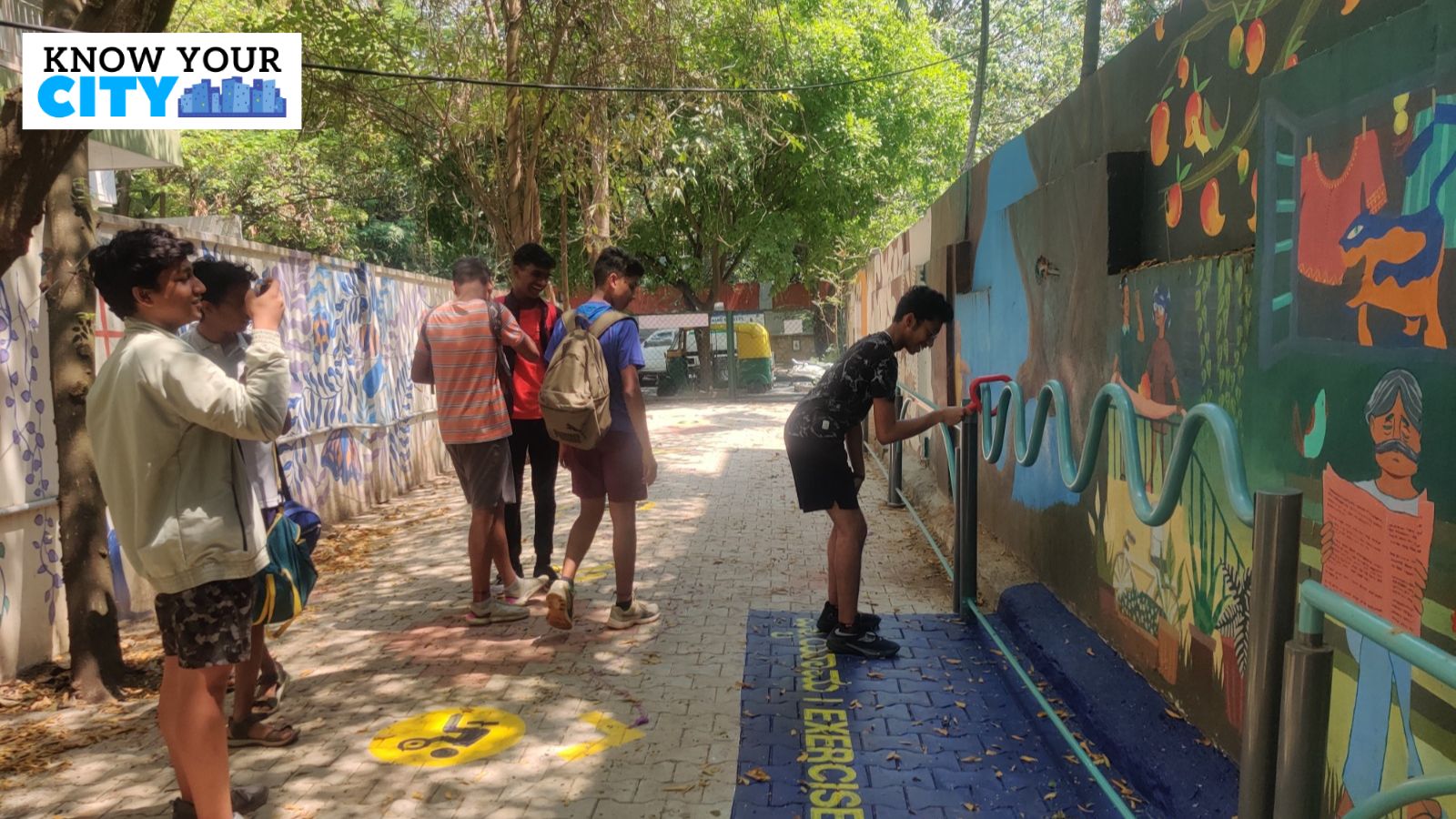
Murals for the Malleswaram Hogona (Let’s go to Malleswaram) art project came up on a conservancy lane parallel to Margosa Road. Another lane near 9th Cross was beautified with murals and floor paintings. The lanes have also received upgrades like hand rails for senior citizens, and exercise machines. Benches and tables have also been put up in some places too. The Walkable Malleswaram project is currently working on signage in the area.
© IE Online Media Services Pvt Ltd
Disclaimer: We do not own any of the content, ideas, images, or text presented here. All rights belong to their respective owners. For more information and to view the original source, please visit the following link: