

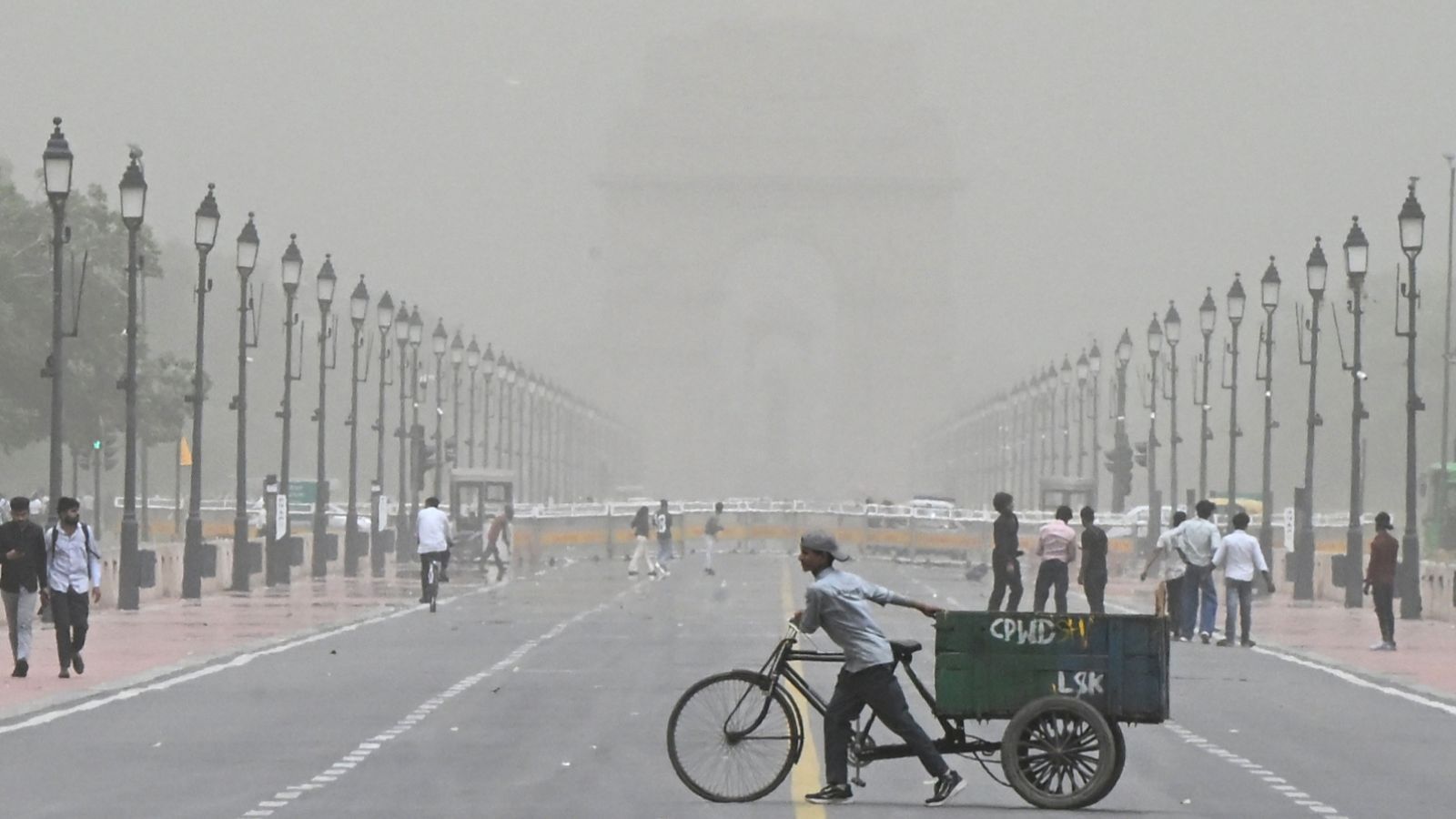
Blue streaks and bright patches pulsed and rapidly spread across the official Palam Doppler weather radar on Monday afternoon.
The India Meteorological Department (IMD) placed the entire NCR under a ‘Red Alert’. By 2.30 pm, Palam had recorded a wind gust of 50 knots — nearly 92 kmph.
Senior IMD scientist Krishna Mishra said a severe squall was reported over Palam, which lasted from 2.28 pm to 2.30 pm.
A squall is a sudden increase of wind speed by at least three stages on the Beaufort scale, with the speed rising to at least 44.4 kmph or more, and lasting for at least one minute, as per the official IMD definitions.
So far, rainfall of 2.3 mm has been detected.
Slew of alerts
The IMD’s latest warning, valid till 5.45 pm, has cautioned that dust storms followed by thunderstorms accompanied by light to moderate rainfall and lightning were very likely across the entire Delhi-NCR.
An ‘Orange Alert’ from earlier in the day had been upgraded to a ‘Red Alert’ as weather conditions intensified rapidly over northwest India.
Story continues below this ad
Radar imagery from Palam showed scattered but intense convective thunderstorm cells over parts of Haryana and adjoining areas west and southwest of Delhi. Unlike widespread rain-bearing systems, these storms were highly localised yet powerful.
The radar signatures indicated significant vertical development within the clouds, which is a hallmark of severe thunderstorms capable of producing sudden wind squalls, dust storms and intense bursts of rain, experts said.
Areas adjoining Delhi have also been placed under alert.
The IMD has warned that thunderstorms accompanied by strong winds were likely over several locations including Sonipat, Rohtak, Jhajjar, Rewari, Bhiwani, Charkhi Dadri, Baghpat and Khekra over the next few hours.
What caused it?
A combination of weather systems currently affecting Northwest India has created favourable conditions for the development of severe thunderstorms.
Story continues below this ad
According to the IMD’s afternoon weather bulletin, the seasonal trough (low pressure area) at mean sea level extends from Punjab to Bihar through Haryana and Uttar Pradesh.
An upper-air cyclonic circulation lies over south Punjab and neighbourhood, while another persists over southeast Pakistan and adjoining southwest Rajasthan.
A western disturbance is also active over north Pakistan and adjoining Jammu and Kashmir.
Together, these systems can cause atmospheric instability across the region, creating conditions conducive to thunderstorm development and strong wind activity.
Story continues below this ad
The week’s forecast
Delhi recorded a maximum temperature of 38.5 degrees Celsius on Sunday, about 1.4 degrees below normal, while the minimum temperature settled at 28.2 degrees Celsius.
The IMD has forecast a fall of 2-3 degrees Celsius in maximum temperatures on Monday owing to cloud cover and thunderstorm activity.
However, the relief is expected to be short-lived. The weather office has forecast a gradual rise in daytime temperatures by 2-4 degrees Celsius after Monday, while minimum temperatures may increase by 3-5 degrees Celsius over the next week.
Maximum temperatures, expected to remain in the 36-38 degrees Celsius range immediately after the storm activity, could climb back to around 40-42 degrees Celsius later this week.
Story continues below this ad
For Tuesday, the IMD has forecast a partly cloudy sky with a spell of very light to light rain accompanied by thunderstorms, lightning and strong winds of 40-50 kmph gusting up to 60 kmph during the afternoon or evening. Another western disturbance is likely to affect northwest India from June 18, which could cause rainfall.
Disclaimer: We do not own any of the content, ideas, images, or text presented here. All rights belong to their respective owners. For more information and to view the original source, please visit the following link: